
14/08/2025
What kinds of allergies appear most often
In summer, high temperatures, increased humidity, and intense outdoor activity favour the appearance of summer allergies. From rashes and itching to redness or swelling, these reactions can be caused by a multitude of factors — plants, insect bites, cosmetics, or even sweat.
Unlike spring allergies, which are caused mainly by pollen, summer allergies manifest through skin reactions and allergic rashes. Although they are often mild, sometimes they require medical evaluation, especially if accompanied by intense swelling or difficulty breathing.
Let’s look at which factors are responsible, how we can identify the type of allergy, and what methods are used to treat it effectively.
Contact with plants, insect bites, cosmetics, and sweat — what causes an allergic reaction
In summer, our skin comes into contact with more allergenic factors. The most common are:
Contact with plants
Some plants and grasses (e.g., ivy, nettle, ivy leaf) contain substances that cause allergic contact dermatitis. The rash usually appears within a few hours and is accompanied by redness, blisters, and intense itching.
Insect bites
Mosquitoes, bees, wasps, and ticks can all cause allergic reactions. In mild cases, local swelling and redness are observed, while in more serious cases (anaphylaxis), it can lead to difficulty breathing or hypotension — conditions requiring immediate medical intervention.
Cosmetics, sunscreens, and deodorants
Sunscreen products, fragrances, and deodorants may contain preservatives, fragrance, or chemical filters that cause irritation or allergy, particularly in people with sensitive skin. Photoallergic dermatitis is characteristic: it appears when the sun “activates” a substance that has been absorbed by the skin.
Sweat and heat
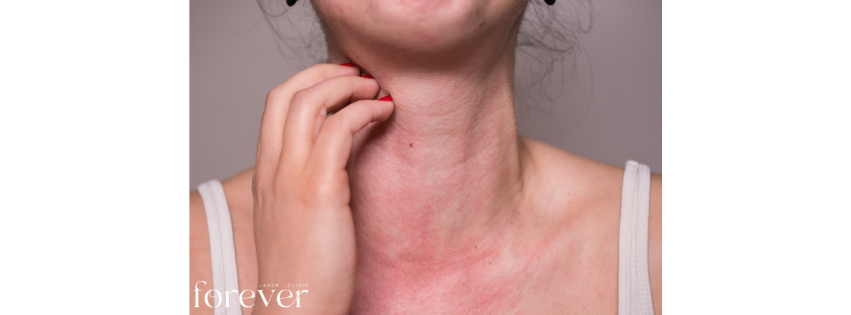
Heat and sweat can cause heat rash (miliaria) or cholinergic urticaria, a form of allergic reaction to a rise in body temperature. These rashes are accompanied by itching and small red lesions, mainly on the trunk and neck.
Sea water and sand
Although the sea often has beneficial effects on the skin, in some people sea water or sand can cause irritation or allergic rashes, especially when there are small wounds or pre-existing dermatitis.
How to identify an allergic rash
Summer allergies usually manifest with a rash, itching, or swelling. However, each type of allergy has certain characteristics that help distinguish the cause.
Allergic contact dermatitis
- Appears a few hours after contact with the allergenic factor.
- Causes redness, swelling, blisters, and intense itching.
- Usually localised to a specific spot (e.g., hand, foot, or neck).
Urticaria
- Rash with reddish, raised marks (wheals) that move or disappear within a few hours.
- Accompanied by intense itching.
- Can be caused by food, medication, sweat, or intense stress.
Photoallergic rash
- Appears after sun exposure.
- Usually affects areas such as the face, neck, hands.
- Accompanied by redness, itching, or blisters.
Reaction from insect bite
- Local swelling and redness at the site of the bite.
- In allergic people, can cause extensive swelling or breathing difficulty, requiring immediate medical help.
Treatment and therapeutic options
The proper treatment of summer allergies depends on the cause, the severity of symptoms, and the patient’s history.
First aid
- Removal of the allergen (e.g., washing the skin after contact with a plant or sunscreen).
- Cool compresses to reduce irritation and swelling.
- Avoid scratching, as it can lead to infection.
Topical treatment
- Antihistamine or corticosteroid creams to reduce itching and inflammation.
- Soothing lotions with aloe, panthenol, or calendula.
- In case of infection, an antibiotic ointment may be needed.
Medication
- Oral antihistamines for relief from itching and rashes.
- In more serious cases, a short course of cortisone may be necessary.
- If there is a history of anaphylaxis, the doctor may suggest a self-injectable adrenaline (EpiPen) for emergency use.
Treatment by a specialist
The dermatologist or allergist may suggest skin tests (patch or prick test) to identify the allergen, so that future exposure can be avoided.
How to prevent recurring episodes
Summer allergies can often be prevented with a few simple but essential changes to daily life:
Skin protection
- Wear clothes that cover the skin when walking in the countryside or grass.
- Apply a sunscreen for sensitive skin, free of fragrance and parabens.
- Avoid cosmetics with fragrance or alcohol.
Dealing with insects
- Use insect repellents suitable for the skin.
- Place screens or mosquito nets in bedrooms.
- Avoid strong fragrances, as they attract insects.
Adjusting to the heat
- Avoid prolonged sun exposure or intense physical activity in high temperatures.
- Prefer cool showers and lightweight cotton clothing.
Dietary and medical prevention
- Inform your doctor about any allergic history or previous reactions.
- In people with recurrent urticaria, preventive treatment with antihistamines may be recommended during the summer.
Conclusion
Summer allergies can cause discomfort, but with proper information, prevention, and medical guidance, they can be effectively controlled. Recognising the type of rash and the irritating factors is the first step to avoiding recurrences.
Take care of your skin with gentle products, good hydration, and sun protection, and consult a specialist if symptoms persist.
Call us today
If you are dealing with rashes or itching that recur in the summer, our dermatologist can guide you with personalised treatments and diagnostic tests that identify the cause.